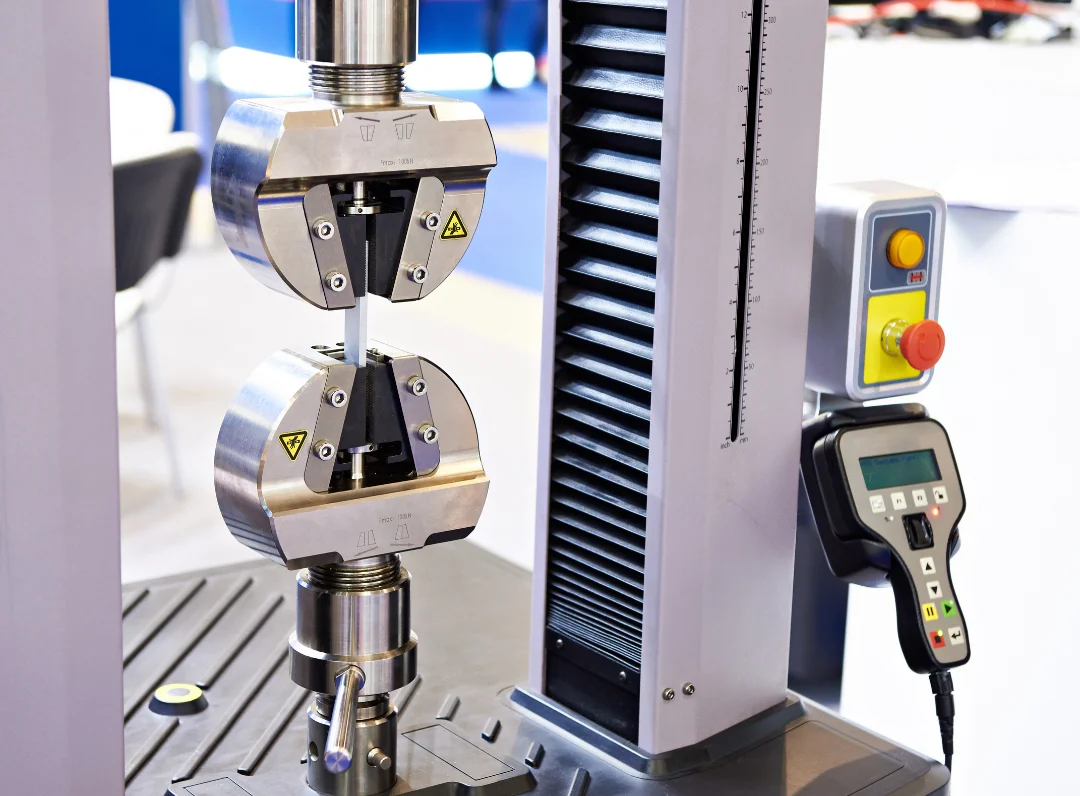
Why Is the Yield–Tensile Test Important? The Importance of Strength in Tie Rods and Formwork Accessories
Formwork systems used in the construction industry are exposed to significant loads and pressure during concrete pouring. The safe transfer of these loads depends on the mechanical strength of the components used in the system, such as tie rods, nuts, plates, and other formwork accessories.
At this point, one of the most critical questions is:
Does the component deform under load (yield), or does it fail by breaking (tensile failure)?
The yield–tensile test is one of the most fundamental mechanical tests used to determine these limits. Through this test, it becomes clear how much load a product can withstand and at which point deformation or fracture may occur.
What Are Yield Strength and Tensile Strength?
Two key values stand out in a yield–tensile test: yield strength (Rp) and tensile strength (Rm).
Yield Strength (Rp)
The yield point is the stage where a material begins to undergo permanent deformation. After this point, the component cannot fully return to its original shape.
In formwork systems, this can lead to several problems such as:
- Thread mismatch or thread damage
- Loosening of the connection
- Reduced load-bearing capacity of the system
For this reason, the yield value is a critical parameter that indicates how long deformation can be delayed.
Tensile Strength (Rm)
Tensile strength represents the maximum stress a material can withstand before breaking.
When this limit is reached, the component approaches the risk of fracture or failure.
In simple terms:
Yield (Rp) → Early warning point
Tensile (Rm) → Final strength limit before fracture
Which Values Are Important in Tie Rods and Nuts?
Tie rod bars and tie rod nuts used in formwork systems are the primary components that carry the concrete pressure. For this reason, three values are especially important in test reports:
Rp – Yield Strength
Indicates the material’s resistance to deformation.
Rm – Tensile Strength
Determines the resistance level against fracture.
A% – Elongation
Shows whether the material behaves in a ductile (tough) or brittle manner.
An important point should be noted:
High tensile strength alone is not sufficient.
If the elongation value (A%) is low, the material may behave more brittle and the risk of sudden fracture increases.
The “Weakest Link” Rule in Formwork Systems
Formwork connections work like a chain, and the strength of a chain is only as strong as its weakest component.
In a typical formwork connection system, the following elements work together:
- Tie Rod
- Tie Rod Nut
- Plate / Cone
- Thread compatibility
- Proper installation
The most common issues encountered on site include:
- Thread stripping or thread crushing
- Loosening due to improper tightening
- Yielding or fracture caused by excessive load
To prevent these risks, it is essential that products are verified through mechanical testing.
What Does the Yield–Tensile Test Provide?
Regular yield–tensile testing offers several advantages:
- Verification of product quality
- Quality control on a lot / heat basis
- Technical evidence in case of potential issues
- Correct product selection and safer usage
In short, a safe formwork system should always be evaluated with the following parameters together:
Rp (Yield) + Rm (Tensile) + A% (Elongation) + Proper Installation + Traceability
Quality and Traceability at GCE Metal
At GCE Metal, we share yield–tensile test reports for the relevant product groups after each shipment. Products are tracked on a lot/heat basis, and traceability is supported through detailed documentation. Upon request, required certificates and documents (e.g., EN 10204 3.1) are prepared and provided to customers. Our goal:To support safe on-site use through transparent documentation and verified quality.

Hi :)
May i help you?
12:20